
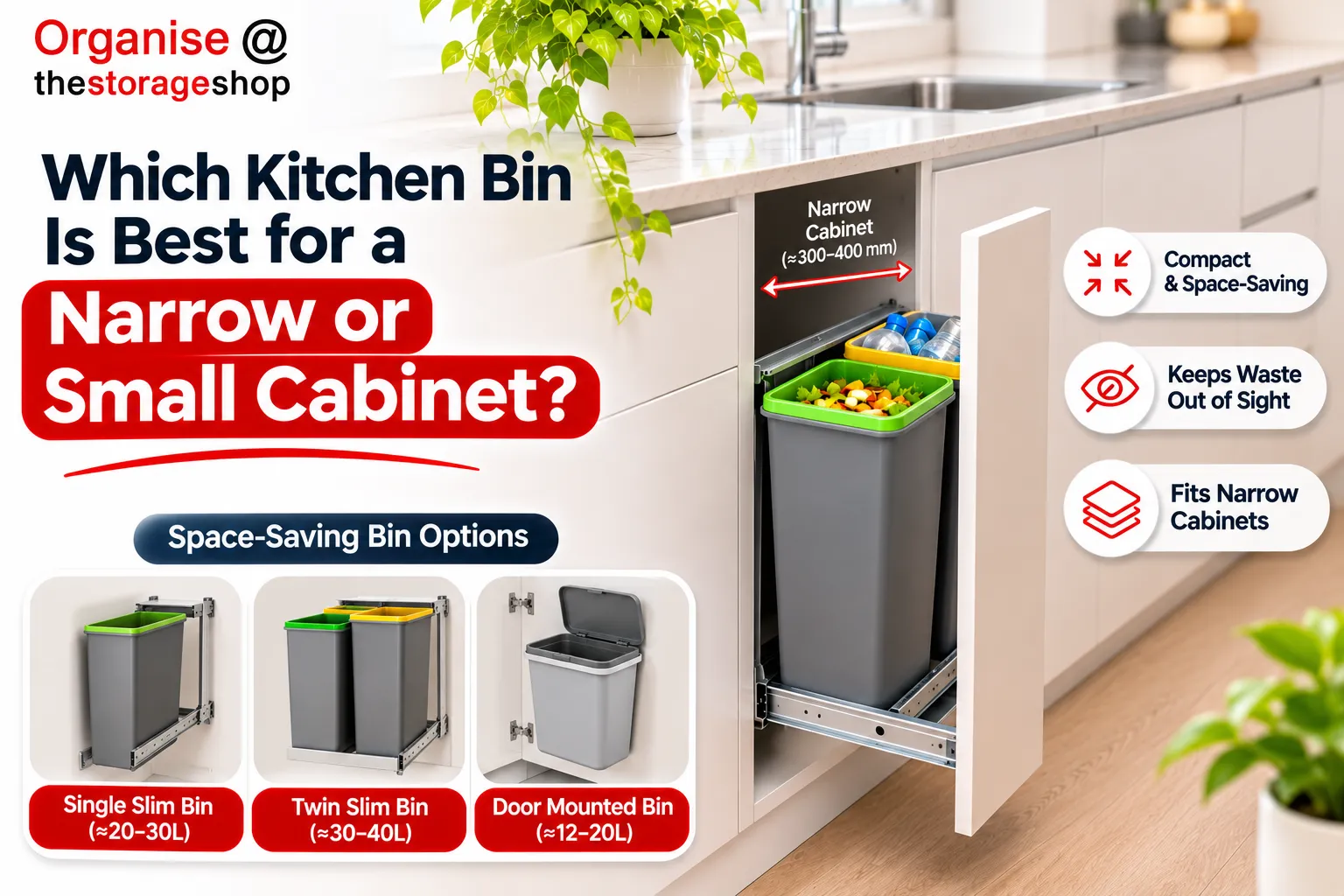
Short answer: For a 300 mm cabinet, a slim pull out bin of about 16 to 34 litres is usually the best fit. It hides rubbish and still slides out fully. If the cupboard is shallow, crowded with plumbing or narrower than 300 mm, a door mounted kitchen bin of 5 to 20 litres is the better choice. Measure the inside of the cabinet before deciding.
Small kitchens rarely have a spare cupboard. Often the only space for a bin is a skinny cabinet at the end of a run, or the cupboard under the sink that’s already full of cleaning gear. The good news is that bins are made for exactly these spaces. The trick is choosing one that fits and still holds enough to be useful.
Start with the inside measurements
A “300 mm cabinet” isn’t 300 mm inside. Side panels are usually 16 mm thick, so you’re left with about 268 mm. That 32 mm difference decides whether a bin fits, so measure:
-
Internal width: between the inside faces of the side panels
-
Depth: from the back of the closed door to the back panel or first obstruction
-
Height: from the cupboard floor to the shelf, benchtop rail or waste pipe above
-
Hinge position: some hinges sit far enough in to catch a frame
Then compare those numbers with the product’s minimum cabinet sizes, not its litre rating.
Option 1: A slim pull out bin
Slim pull out kitchen bins are made for 300 mm cabinets. The frame screws to the cupboard floor, or fixes to a drawer-style front, and the buckets slide forward on runners.
What fits a 300 mm cabinet:
-
a single bin of roughly 15 to 30 litres
-
a slim double of around 30 litres, made up of two smaller buckets
-
a double of up to about 34 litres in some models
Single or double? In a narrow cabinet, a double means two quite small buckets. They fill quickly, and a pizza box or cereal packet won’t go in without folding. If your recycling already lives in a crate in the laundry, a single bucket often works better day to day. If you sort everything in the kitchen, the double is worth it.
You can compare 300 mm and 400 mm models in the pull out kitchen bins range.
Option 2: A door mounted kitchen bin
When the cabinet is shallow, narrower than 300 mm or blocked by pipes, a door mounted kitchen bin is the answer. These small bins, typically 5 to 20 litres, hang on the inside of a hinged door and swing out as it opens.
They’re best for:
-
food scraps right next to the prep area
-
sink cupboards where the trap leaves no room for a frame
-
apartments where one person or a couple produce little waste
They aren’t really a main household bin. Most families pair one with a larger bin elsewhere. Before buying, check that the door and hinges can take the weight of a full bucket. Browse door mounted kitchen bin styles to find one that suits your door.
Option 3: Split the job across two spaces
This is the solution many small kitchens end up with, and it’s often the smartest. Instead of forcing everything into one tiny cabinet:
-
put a small door bin for food scraps under the sink
-
keep a slim pull out bin in another narrow cabinet for general rubbish
-
move recycling to the laundry, a pantry floor or outside
Each bin stays small, but together they handle more waste than one cramped unit could.
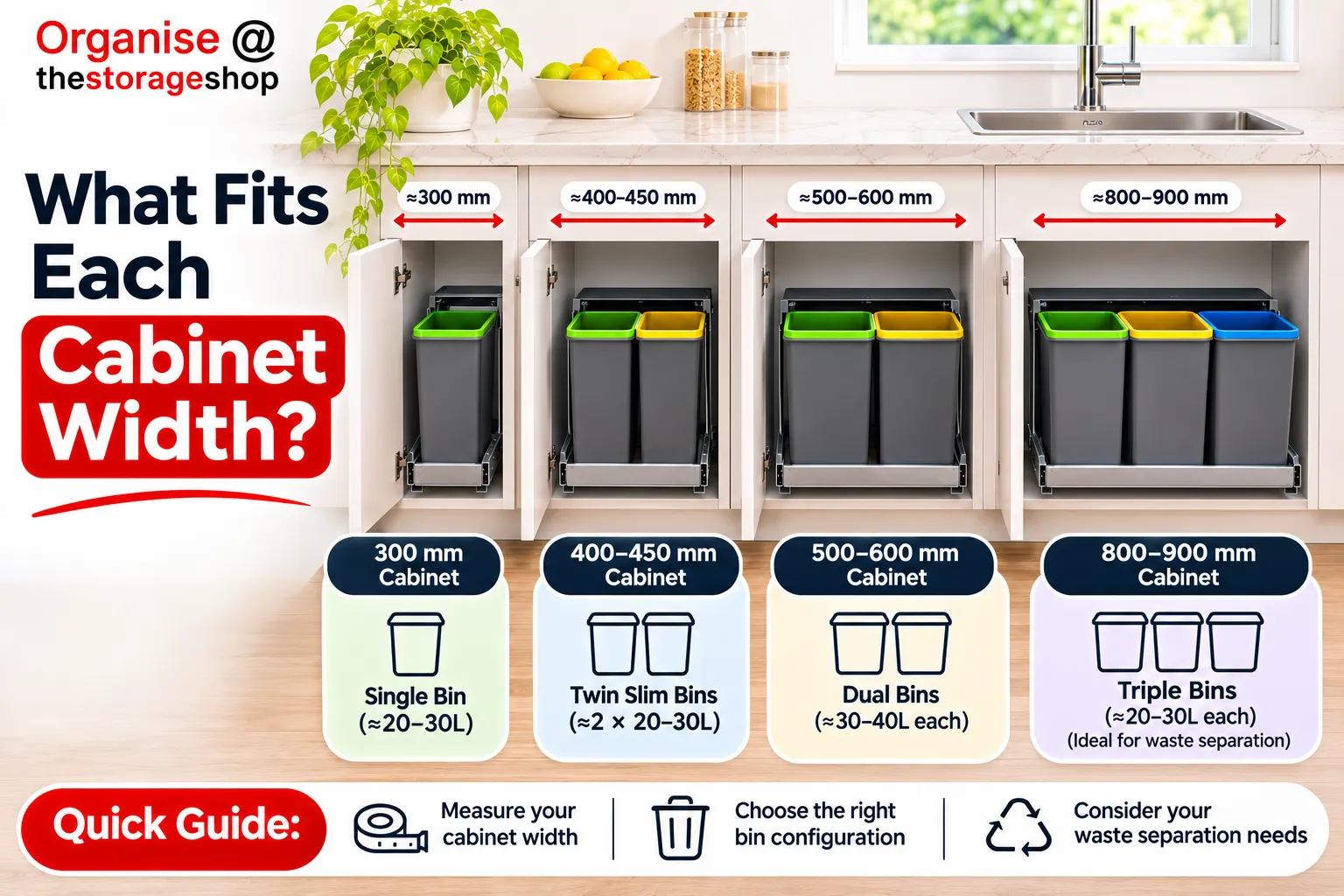
What fits each cabinet width?
|
Cabinet width |
Approx. inside |
Typical bin options |
|
Under 300 mm |
Under 268 mm |
Door mounted bin, roughly 5–20 L |
|
300 mm |
About 268 mm |
Slim pull out, roughly 16–34 L |
|
400 mm |
About 368 mm |
Single or double pull out, up to about 64 L |
These are guides, not guarantees. Bins with the same capacity can differ in height and depth, so always check the product’s own dimensions.
Don’t forget the drawer option
If your small kitchen has deep pan drawers, a drawer bin insert may suit you better than a cupboard bin. The buckets sit inside the drawer and come out every time you open it. Inserts are made for specific drawer systems, so match the brand and width before buying.
Small-kitchen habits that help
-
Empty little and often. A 20-litre bin emptied every day or two holds as much over a week as a much bigger one emptied weekly.
-
Flatten packaging. It’s the quickest way to stretch a small bin.
-
Choose removable buckets. You’ll be lifting them out more often, so make them easy to rinse.
-
Go for soft-close. In a compact kitchen, a banging bin is hard to ignore.
Are kitchen bins in cupboards worth it in a small kitchen?
Usually, yes. A freestanding bin in a narrow kitchen takes up floor you can’t spare and ends up in the way of the dishwasher or oven door. Moving the bin into a cupboard gives you that floor back and keeps the walkway clear. The trade-off is giving up a cabinet, or part of one, so use the narrow cabinet that’s hardest to store anything else in.
Frequently asked questions
Can a pull out bin fit a 300 mm cupboard?
Yes. Most slim models are designed for 300 mm cabinets, which are about 268 mm inside, and hold roughly 16 to 34 litres.
What’s the smallest kitchen bin that still works?
A door mounted bin of around 5 litres handles food scraps if you empty it daily. For general rubbish, aim for at least 15 to 20 litres.
Is a double bin worth it in a narrow cabinet?
Only if you sort recycling in the kitchen. Otherwise, one larger bucket is easier to live with.
The bottom line
In a 300 mm cabinet, a slim pull out bin is the most practical choice. For shallow, cramped or extra-narrow spaces, use a door mounted bin. And if one small cabinet can’t do it all, split scraps, rubbish and recycling across two or three spots. Measure inside first, then pick the bin that fits comfortably.
