
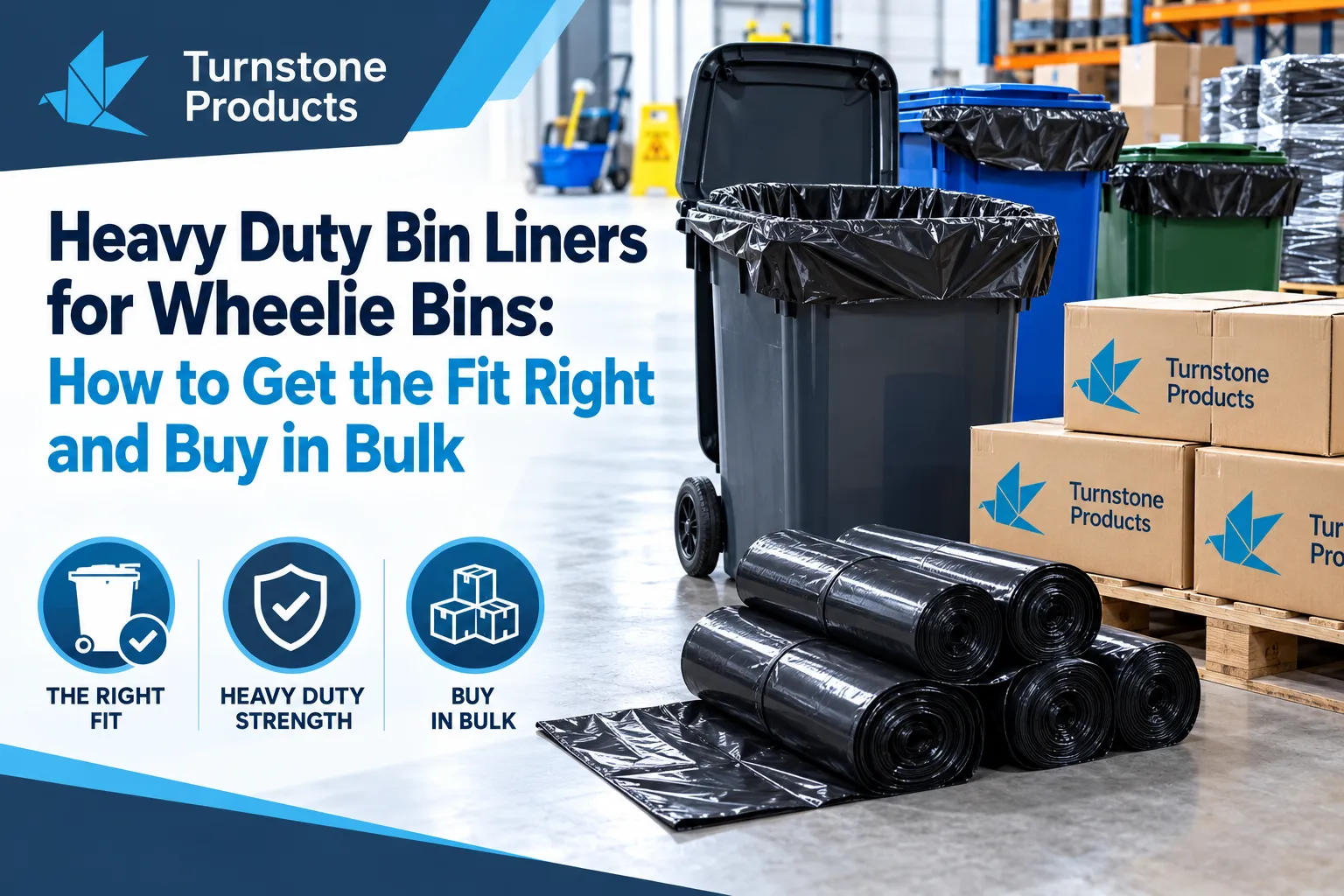
Quick answer: Measure the wheelie bin’s opening and depth, then match those numbers to the liner’s dimensions rather than the litre label. Use a 25 micron heavy duty grade for bagged or mixed waste and 30 micron extra heavy duty for loose, heavy or sharp-edged loads. Work out your weekly usage before ordering by the carton.
Walk behind almost any restaurant, warehouse or shopping centre and you’ll find a row of wheelie bins doing the hard work. You’ll also find the classic problem: a liner that has slipped down inside the bin, leaving rubbish stuck to the bottom and a cleaner reaching in to fish it out.
Most of the time the bag isn’t faulty. It’s simply the wrong size or the wrong grade for the bin and the waste. Getting heavy duty bin liners right comes down to measuring properly, choosing the grade for the load and ordering enough to avoid running out.
Why the Litre Rating Doesn’t Tell You the Fit
A 240L label tells you roughly how much the bin holds, not its shape. Bins from different manufacturers vary in height, width and how they taper, so a liner sold as “240L” won’t suit every 240L bin.
When choosing bin liners for wheelie bins, two dimensions matter. Width decides whether the bag reaches around the rim. Length decides whether it reaches the base with enough left over to fold over the top.
How to Measure a Wheelie Bin for a Liner
You only need a tape measure and five minutes:
-
Measure around the opening. Add up all four sides of the rim. A liner’s flat width is half its opening, so the flat width needs to be at least half that perimeter, plus some slack.
-
Measure the internal depth. Go from the rim straight down to the base.
-
Allow extra length. The liner should reach the bottom without being pulled tight and still fold well over the rim so it can’t slip.
-
Compare with the liner’s stated dimensions, which are given as flat length × width.
-
Trial one carton before committing to a large standing order.
If the bag reaches the base but stretches tight at the rim, you need more width. If it fits the rim but doesn’t reach the bottom, you need more length.
120L or 240L? Compare the Dimensions
Here’s how Turnstone Products’ large wheelie bin bags compare:
|
Liner |
Thickness |
Dimensions |
Per carton |
|
120L Heavy Duty |
25 micron |
1200 × 1140 mm |
100 |
|
240L Heavy Duty |
25 micron |
1450 × 1150 mm |
100 |
|
240L Extra Heavy Duty |
30 micron |
1450 × 1150 mm |
100 |
Notice that the 120L and 240L liners are almost the same width. The real difference is length: the 240L is 250 mm longer. So a 120L liner in a full-size 240L bin won’t reach the base, and waste ends up underneath the bag. Choose by the bin’s depth, not its badge.
Heavy Duty or Extra Heavy Duty?
Thickness changes strength, not capacity. Both 240L grades hold the same volume in the same size bag.
Heavy duty at 25 micron is usually enough where waste goes in already bagged, or the bin collects light mixed rubbish and is wheeled straight to collection. Extra heavy duty at 30 micron suits bins taking loose waste, wet food scraps, broken packaging with sharp edges, or liners that are lifted out and carried to a skip.
Don’t over-specify: the heaviest grade in every bin adds cost and plastic for no benefit.
Working Out a Bulk Order
Wheelie bin liners are a classic bulk item: same size, used every day. To size an order of the heavy duty bin liners bulk buyers go through, start with a simple sum:
Liners per week = number of bins × changes per bin per week
A site with 8 wheelie bins changed 5 times a week uses 40 liners. At 100 liners per carton, one carton lasts about two and a half weeks. Add a buffer to cover delivery time and busy periods, and set a reorder point so the storeroom never runs dry.
When comparing quotes, work out the cost per bag by dividing the carton price by the number of liners inside. Only compare liners with the same dimensions and thickness, because a cheaper bag that doesn’t fit isn’t a saving.
Buying Wheelie Bin Liners in Perth
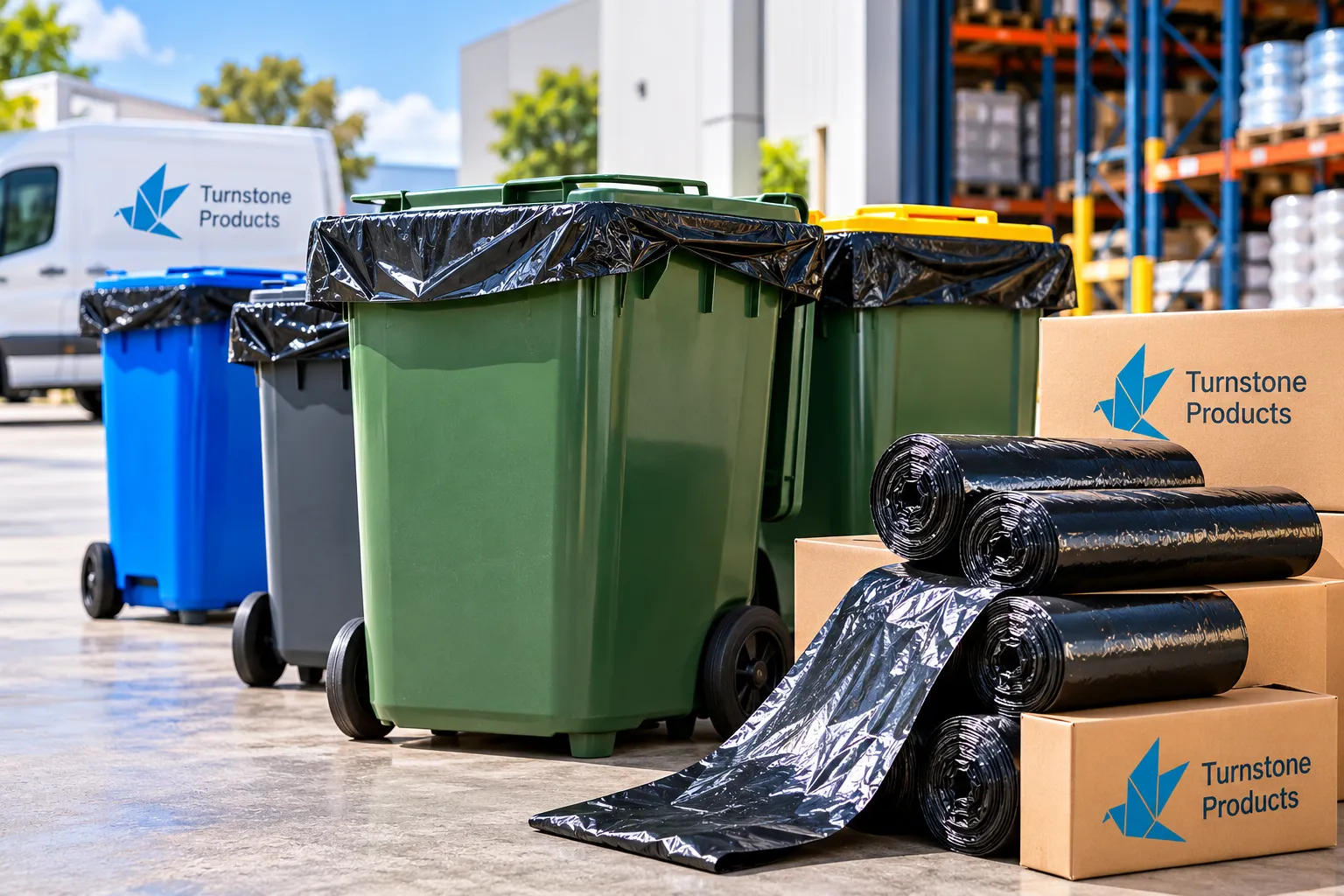
Turnstone Products, a West Australian family-owned supplier based in Neerabup, stocks 120L and 240L liners alongside its full range from 18L kitchen tidy bags upward. Liners are supplied by the carton, with next-day delivery across Perth metro. Bulk pricing is quoted per site, and the team can help confirm the right size and grade for your bins.
Frequently Asked Questions
What size bin liner fits a 120L wheelie bin?
A 120L wheelie bin needs a liner long enough to reach the base and wide enough to fold over the rim. Turnstone Products’ 120L heavy duty liner measures 1200 × 1140 mm at 25 micron. Bins vary between manufacturers, so measure the rim and depth before ordering in bulk.
Should I use heavy duty or extra heavy duty liners in a wheelie bin?
Use heavy duty (around 25 micron) when waste is already bagged or light and mixed. Choose extra heavy duty (around 30 micron) for loose, wet or heavy waste, sharp-edged packaging, or when full liners are lifted out and carried. Both grades come in the same dimensions, so the choice is about strength.
How many bin liners are in a carton?
It depends on the size. Turnstone Products’ 120L and 240L liners come in cartons of 100, packed as four rolls of 25. Smaller sizes can come in larger quantities (Turnstone’s 90L liners are 250 to a carton), so always check the count when comparing prices.
How do I work out how many bin liners I need?
Multiply the number of bins by how many times each is changed per week to get weekly usage. Divide your carton size by that figure to see how many weeks a carton lasts, then add a buffer for delivery time and busy periods.
Final Thoughts
Most wheelie bin liner problems come down to fit, not quality. Measure the bin, choose the size by its depth and width, match the grade to the waste, and order by the carton based on real usage. That’s how you stop liners slipping, splitting and running out.
