
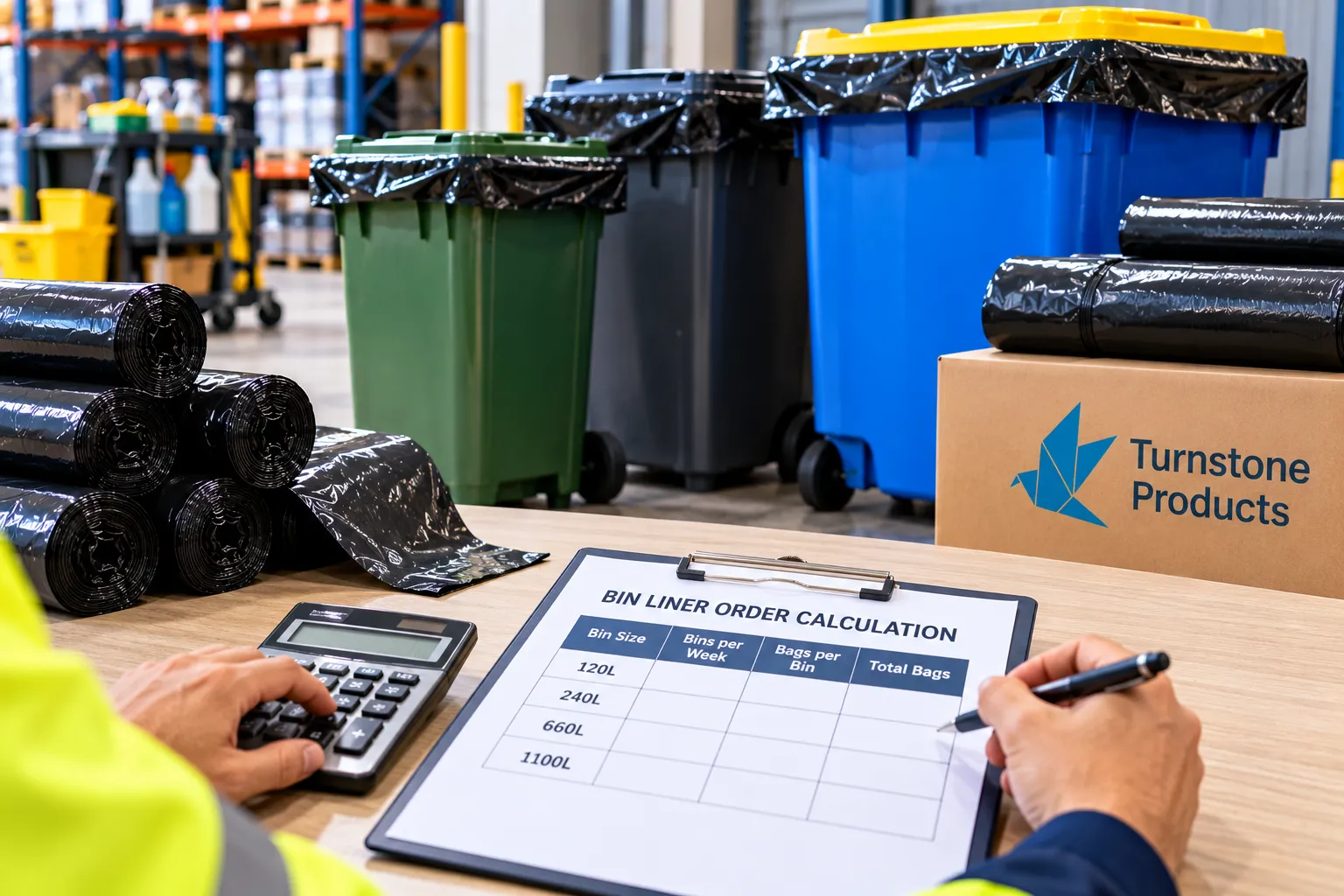
Quick answer: To size a bulk bin liner order, list your bins by liner size, multiply each by its changes per day and operating days, then divide by the liners per carton and round up. Subtract the stock you already hold and add a safety buffer. Work out each liner size separately, because they’re ordered as separate products.
Most businesses order bin liners by feel. Someone notices the storeroom looks thin, rings the supplier and orders “the usual”. Then a busy fortnight hits and the dock runs out of 240L bin bags, while three untouched cartons of kitchen tidy liners sit on the shelf.
A few minutes with a calculator fixes that. Whether you’re buying industrial bin liners for a warehouse or small liners for an office, the method is the same: count, multiply, convert to cartons, then adjust for what’s already on hand.
Step 1: List Every Bin by Liner Size
Walk the site and count every bin, including the ones tucked under desks and in washrooms. Note the liner each bin takes and how often it’s changed.
|
Area |
Bins |
Liner |
Changes per day |
Liners per day |
|
Offices |
10 |
36L |
1 |
10 |
|
Staff kitchen |
4 |
72L |
2 |
8 |
|
Warehouse floor |
6 |
90L |
1 |
6 |
|
Loading dock |
2 |
240L |
1 |
2 |
|
Total |
26 |
Illustrative example.
Daily use = number of bins × changes per bin per day
Step 2: Turn Daily Use into Weekly and Monthly Figures
Multiply by the days your site operates. This example runs five days a week:
|
Liner |
Per day |
Per week |
Per 4 weeks |
|
36L |
10 |
50 |
200 |
|
72L |
8 |
40 |
160 |
|
90L |
6 |
30 |
120 |
|
240L |
2 |
10 |
40 |
For a monthly budget, multiply weekly use by 52 and divide by 12, since a calendar month is longer than four weeks. Here, 130 liners a week works out to about 563 a month.
Step 3: Convert Liners into Cartons
Most suppliers sell bin liners bulk, by the carton, and the bag count varies a lot by size. Turnstone Products’ range, for example, packs:
|
Liner sizes |
Liners per carton |
|
18L, 27L and 36L kitchen tidy |
1,000 |
|
54L, 72L, 80L and 90L |
250 |
|
120L and 240L |
100 |
Cartons needed = liners needed ÷ liners per carton, rounded up
If you need 620 of a 250-pack liner, 620 ÷ 250 = 2.48, so order 3 cartons. When comparing quotes from different suppliers, always check the bag count, as carton price alone tells you nothing.
Watch the slow movers. In the example above, one carton of 36L liners covers 20 weeks, so it shouldn’t be reordered every month just because the 240L bags are running low.
Step 4: Subtract What You Already Hold
Overordering usually happens because nobody checks the storeroom first. Use this instead:
Order = forecast use + target closing stock − stock on hand − deliveries already due
Say you forecast 300 liners for the period, want 100 left at the end, and have 180 on the shelf. That’s 300 + 100 − 180 = 220 liners, or one carton of 250.
Step 5: Set a Reorder Point
A reorder point tells staff exactly when to order, so it never depends on someone noticing.
Safety stock = daily use × reserve days Reorder point = daily use × delivery lead time + safety stock
A warehouse using 20 liners a day, with two-day delivery and a three-day reserve, needs 40 + 60 = 100 liners. When stock drops to 100, the order goes in.
Adjust for Busy Seasons
Usage rises at Christmas, during events and in peak dispatch periods. Check last year’s figures and scale up. If a site normally uses 500 liners a month and expects a 30% jump, plan for 650.
Let a Spreadsheet Do the Work
Set up one row per liner size with columns for bins (B), changes per day (C), operating days (D), forecast (E), target closing stock (F), stock on hand (G), deliveries due (H) and liners per carton (I). Then use:
-
Forecast liners: =B2*C2*D2
-
Cartons to order: =ROUNDUP(MAX(0,E2+F2-G2-H2)/I2,0)
Update it whenever bin numbers or cleaning schedules change.
Getting an Accurate Quote in Perth
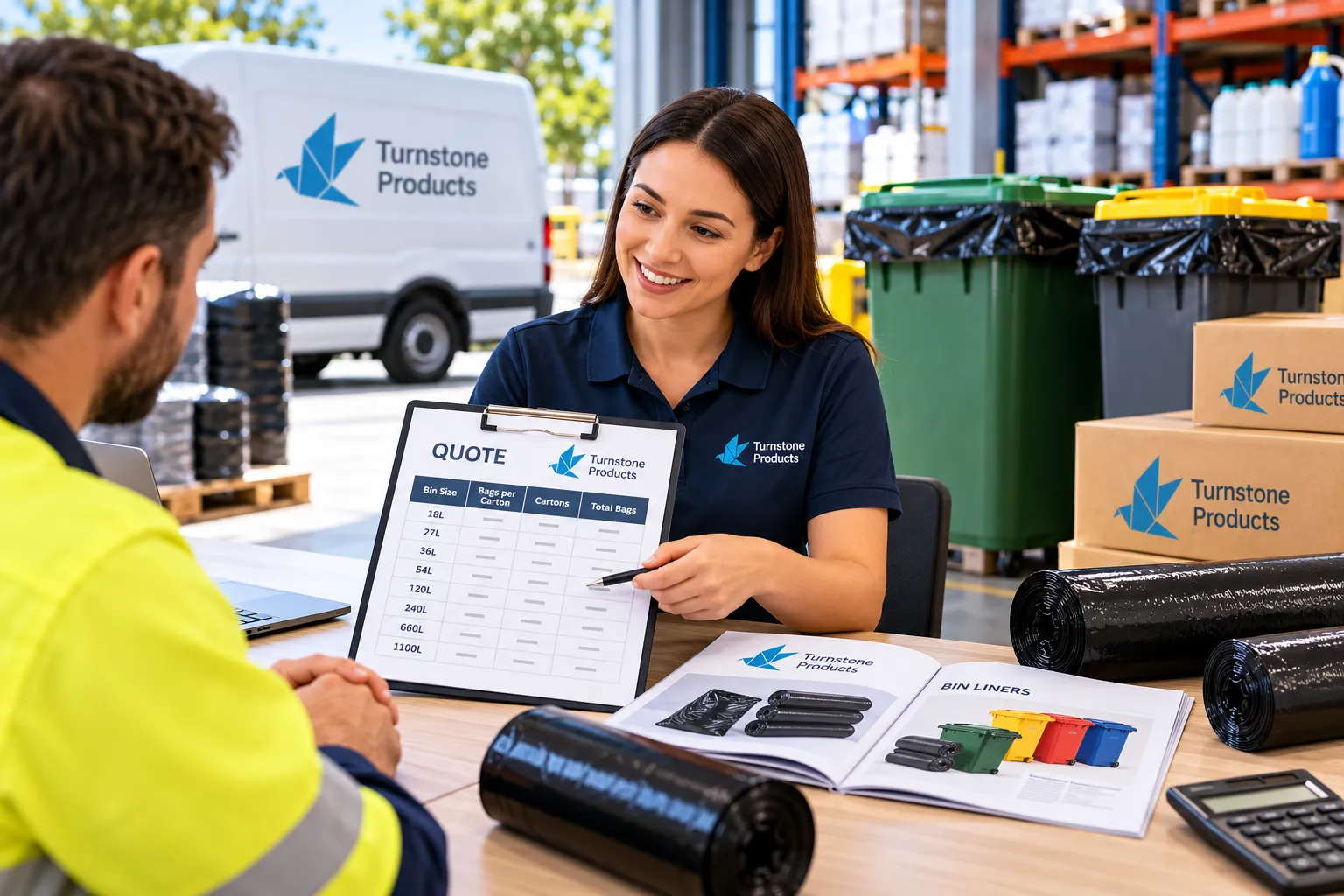
Your finished sheet is exactly what a supplier of wholesale bin liners needs to quote properly. Turnstone Products, a West Australian family-owned supplier in Neerabup, stocks 16 bin liner sizes and grades from 18L to 240L, supplied by the carton with next-day delivery across Perth metro. Send the team your bin list and monthly usage for a bulk quote.
Frequently Asked Questions
What are industrial bin liners?
Industrial bin liners are heavy-gauge rubbish bags made for warehouses, factories, loading docks and other high-volume sites. They’re usually black, 25 to 38 micron thick, and come in large sizes up to 240L wheelie bin liners. They’re sold in bulk cartons rather than retail packs.
How long does a carton of bin liners last?
Divide the liners per carton by your weekly usage. A 250-liner carton used at 40 liners a week lasts just over six weeks, while a 100-liner carton of 240L bags used at 10 a week lasts ten weeks. Busy periods will shorten that.
Is it cheaper to buy bin liners in bulk?
Usually, yes. Buying by the carton generally lowers the cost per liner and cuts ordering time. Compare the cost per bag (carton price divided by liners per carton) for liners of the same size and thickness, and only buy what you’ll use within a few months.
Where can I buy wholesale bin liners in Perth?
Perth businesses can buy wholesale bin liners from local B2B suppliers that sell by the carton. Turnstone Products in Neerabup stocks liners from 18L kitchen tidy to 240L wheelie bin size, with next-day delivery across Perth metro. Call (08) 9456 0992 for bulk pricing.
Final Thoughts
Bin liner ordering doesn’t need guesswork. Count your bins by size, work out weekly use, convert to cartons, subtract stock and set a reorder point. Ten minutes with a spreadsheet saves a lot of panic orders and dusty overstock.
