
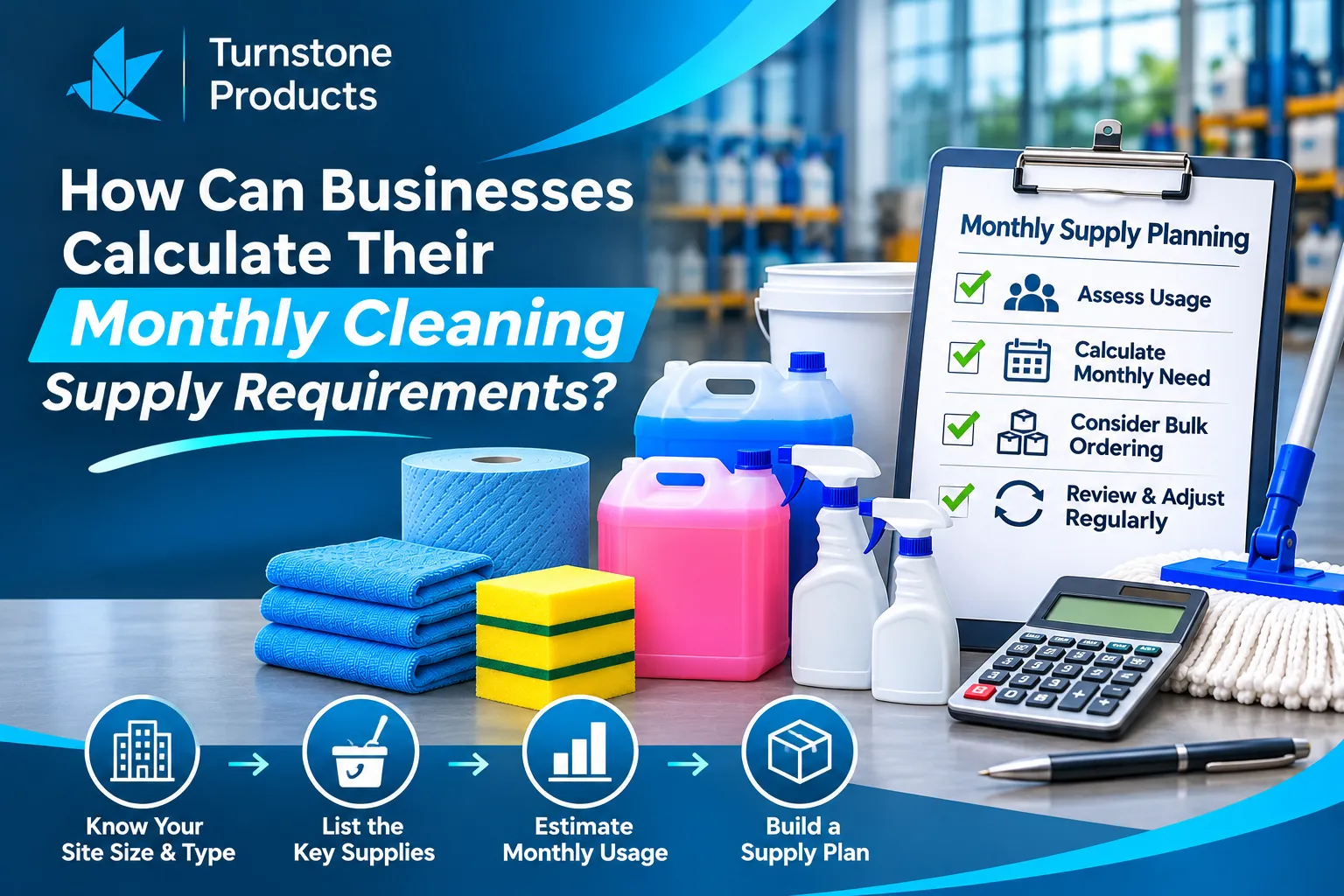
Quick answer: Multiply average daily usage of each product by the number of days your site operates each month, add a few days of reserve stock, subtract what you already have on the shelf, then round up to full cartons. Recheck the numbers every few months as staff numbers, trading levels and seasons change.
Most businesses order cleaning supplies by feel. Someone glances at the storeroom, decides it “looks a bit low” and orders the same as last time. Sometimes that works. Other times the site runs out of hand towels mid-week, or the storeroom fills with cartons of a chemical nobody uses much.
A few minutes of maths fixes this. Whether you run an office, restaurant, childcare centre or warehouse, knowing your real monthly usage helps you order the right amount, budget accurately and keep the storeroom tidy.
Businesses buying cleaning supplies perth can use the simple method below. All you need is a notepad or a basic spreadsheet.
Step 1: List the Products You Use Regularly
Start with the items your site goes through every week. For most workplaces, that list includes:
-
Toilet paper and paper hand towels
-
Bin liners
-
Cleaning chemicals and disinfectants
-
Disposable gloves
-
Hand soap and sanitiser
-
Floor cleaning products
-
Cloths and cleaning accessories
Split the list in two: high-use items you buy every month, and occasional items you buy a few times a year. Focus your calculations on the first group. The occasional items can simply be checked during your monthly review.
Step 2: Measure Daily Usage
Guessing is where most estimates go wrong, so measure instead. Choose two to four normal weeks and record how much of each product is used.
The easiest way is to count stock at the start and end of the period, adding anything delivered in between. Divide the amount used by the number of operating days, and you have average daily usage.
For example, if an office starts the fortnight with 80 toilet rolls, receives no deliveries and finishes with 30, it used 50 rolls over 10 working days. That is five rolls a day.
Avoid measuring during unusual weeks, such as Christmas shutdowns or a major event, as these distort the average.
Step 3: Work Out Your Monthly Requirement
Now apply a simple formula:
Monthly requirement = average daily usage × operating days per month
Using the office example: 5 rolls × 22 operating days = 110 rolls per month.
Here is how that looks for a typical Perth office across several products:
|
Cleaning product |
Daily usage |
Operating days |
Monthly requirement |
|
Toilet paper |
5 rolls |
22 |
110 rolls |
|
Paper towels |
3 packs |
22 |
66 packs |
|
Bin liners |
10 bags |
22 |
220 bags |
|
Disposable gloves |
20 pairs |
22 |
440 pairs |
These figures are illustrative. Use your own measured usage.
Remember that operating days vary by business. A café trading seven days a week might have 30 operating days, while a childcare centre might have around 21.
Step 4: Add Reserve Stock
Your monthly requirement covers normal use. Reserve stock covers the unexpected: a delivery running late, a busy week, or a product being temporarily unavailable.
A practical approach is to hold a few days’ extra usage for each essential item. The right amount depends on how quickly your supplier delivers and how critical the product is. Running out of toilet paper is a bigger problem than running out of glass cleaner.
If the office keeps five extra days of toilet paper, that is 5 × 5 = 25 reserve rolls. Its target stock becomes 110 + 25 = 135 rolls.
Step 5: Subtract What You Already Have
This is the step many businesses skip, and it is why storerooms overflow. Before ordering, count the usable stock already on hand.
If the office has 30 rolls on the shelf, it needs 135 − 30 = 105 rolls to reach its target.
Step 6: Convert to Full Cartons
Suppliers sell by the carton, so the final step is to convert your number into cartons and round up.
Say the office’s toilet paper comes in cartons of 48 rolls. It needs 105 rolls, and 105 ÷ 48 = 2.19 cartons, so it orders three cartons. The extra rolls simply count towards next month’s stock.
Carton sizes vary between products and suppliers, so check the pack quantity on your quote.
Repeat this for each high-use item and you have a complete, justified monthly order in about ten minutes.
Know When to Reorder Between Orders
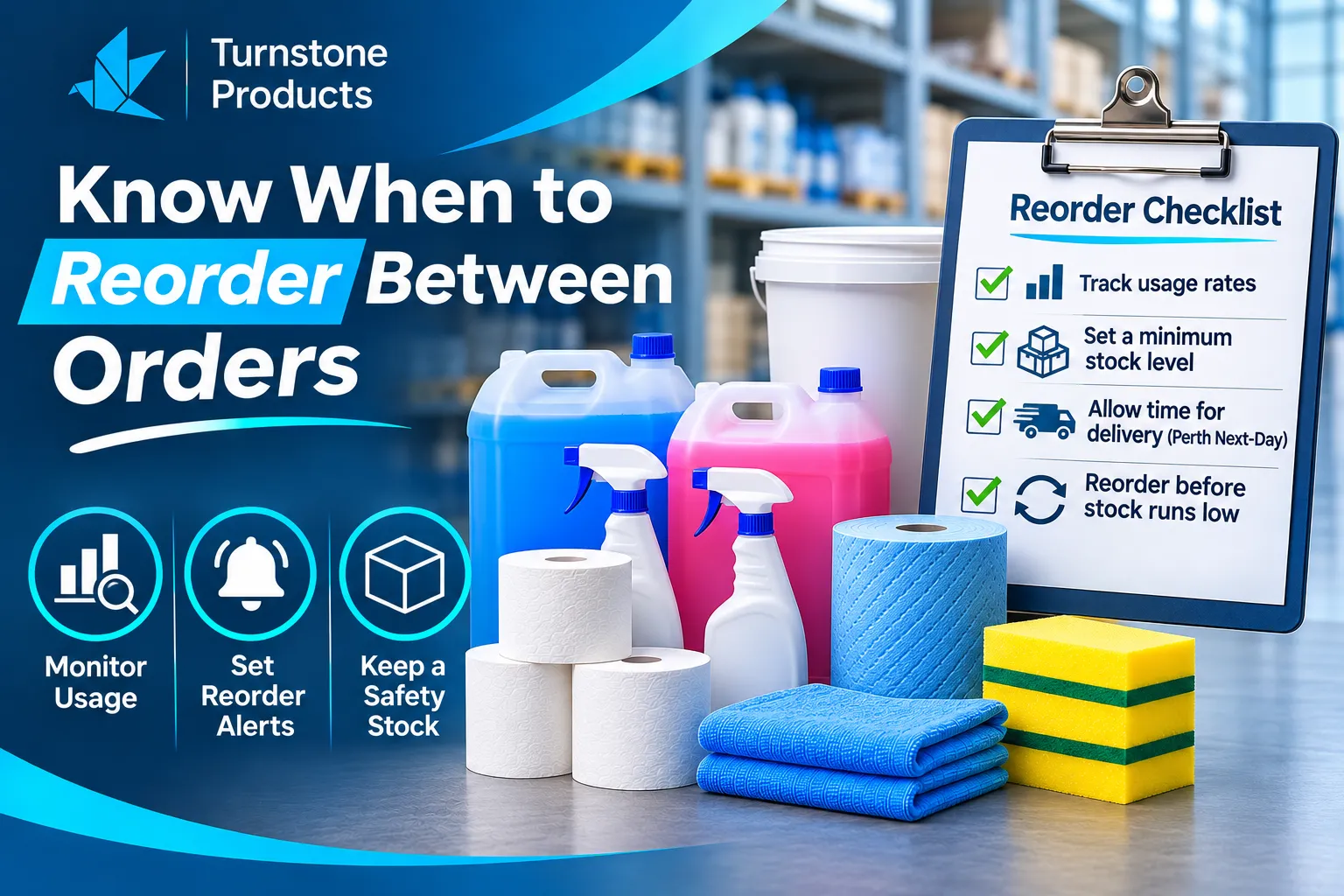
If you order more often than monthly, a reorder point tells you when to buy. Use this formula:
Reorder point = (daily usage × delivery lead time) + reserve stock
A business using 10 bin liners a day, with a two-day delivery time and 30 liners in reserve, reorders when stock drops to (10 × 2) + 30 = 50 liners.
What Changes Your Monthly Usage?
Your numbers are a snapshot, not a permanent rule. Revisit them whenever something below changes:
-
Headcount and visitors. More people means more washroom paper, soap and waste.
-
Industry and cleaning frequency. A commercial kitchen cleans surfaces many times a day, while an office may do so once. Businesses using commercial cleaning supplies should base their figures on their own cleaning routines, not another industry’s averages.
-
Seasons and trading peaks. Hospitality venues get busier over summer and the festive season. Schools and childcare centres follow term patterns.
-
New services or sites. Taking on a new contract or opening another location changes everything.
Looking at last year’s invoices is a quick way to spot seasonal patterns before they catch you out.
Should You Order in Bulk?
Once you know your monthly requirement, bulk buying becomes much safer, because you know exactly how much you will use. When comparing wholesale cleaning supplies perth suppliers offer, look at the unit price, carton size, delivery charges and how many months of stock a bulk order represents.
High-use products such as toilet paper, paper towels, bin liners and gloves are usually good bulk candidates. Be more cautious with chemicals. Check shelf life and storage instructions, especially in a Perth summer when unairconditioned storerooms can get very hot.
Why Choose Turnstone Products?
Turnstone Products is a Western Australian, family-owned supplier of commercial and industrial cleaning products, operating from its warehouse in Neerabup. It supplies businesses across hospitality, childcare, healthcare and commercial cleaning throughout Perth.
-
Quotes built around your usage. Share your monthly requirements and receive an itemised quote. Bulk orders are arranged by contacting the team, not through online checkout.
-
Stock held locally. Products are kept at the Neerabup warehouse, ready to go.
-
Next-business-day delivery. Eligible Perth metro orders, from Yanchep to Mandurah, arrive the next business day, so you can hold less reserve stock.
-
One order for everything. Cleaning chemicals, toilet paper, hand towels, bin liners, gloves and dispensers in a single delivery.
-
Australia-wide supply for bulk orders. Sites outside Perth can also arrange bulk supply.
Frequently Asked Questions
How do I calculate how many cleaning supplies I need each month?
Multiply average daily usage by your operating days per month, add reserve stock, subtract what you already have, and round up to full cartons.
How much reserve cleaning stock should a business keep?
Most businesses keep a few days of extra usage for essential items. Keep more if deliveries are slow or the product is critical, such as toilet paper or hand soap.
How often should I review my cleaning supply usage?
Check high-use stock weekly and review your monthly calculations every quarter, or sooner if staff numbers or trading levels change.
Conclusion
Working out monthly cleaning supply requirements takes the guesswork out of ordering. Measure what you use, multiply by your operating days, add a sensible reserve, subtract what is on the shelf and round up to full cartons. Perth businesses that follow this routine avoid shortages, keep their storerooms under control and know exactly what they are spending each month.
