
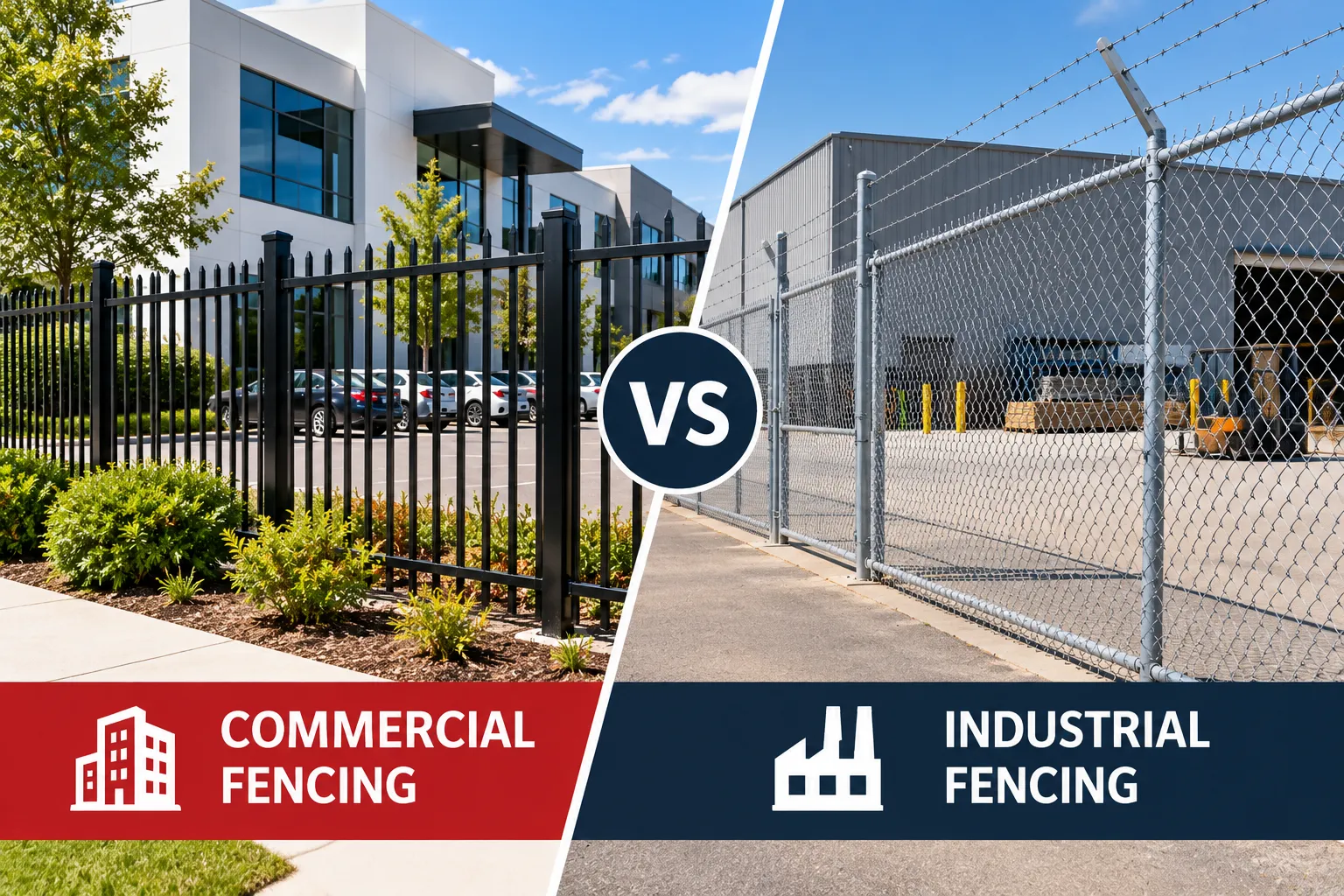
A fence around an office park and a fence around a truck depot can look alike from the road, but they’re built for different jobs. Pick the wrong one and you pay for it in security, convenience or money.
The short answer: commercial fencing balances security, access and appearance for offices, shops and schools, while industrial fencing puts strength and asset protection first for factories, warehouses and depots. The right choice depends on your site’s risks, traffic and budget, not the label.
What Is Commercial Fencing?
Commercial fencing is perimeter fencing for business premises that deal with the public, such as offices, retail centres, schools, car yards and business parks. Its job is to secure the boundary without making the site feel locked down.
That means good visibility, clean lines and easy entry for staff, customers and visitors. Garrison, C-Thru, tubular steel and chain mesh are the usual choices.
What Is Industrial Fencing?
Industrial fencing is built for sites where physical security and operational safety come first: factories, warehouses, distribution centres, transport depots and storage yards. These sites often hold expensive machinery or stock and see heavy vehicle traffic all day.
Palisade and heavy-duty chain mesh are common here. Still, not every industrial site needs maximum protection. A small warehouse storing low-value goods has very different needs from a utility substation.
Key Differences at a Glance
|
Feature |
Commercial fencing |
Industrial fencing |
|
Main purpose |
Security, access and appearance |
Asset protection and operational safety |
|
Typical sites |
Offices, retail, schools, car yards |
Factories, warehouses, depots, yards |
|
Appearance |
Often a priority |
Usually second to function |
|
Common materials |
Garrison, C-Thru, tubular steel, chain mesh |
Palisade, heavy-duty chain mesh |
|
Who needs access |
Staff, customers, visitors |
Trucks, machinery, authorised staff |
|
Typical gates |
Pedestrian gates, car park entries |
Wide sliding gates, often automated |
These are tendencies, not hard rules. The same fence can suit both kinds of site if its specification fits.
Which Fence Types Suit Each Site?
The best material isn’t always the strongest or the dearest. It’s the one that fits how your site is used.
-
Garrison: steel vertical rails fixed to horizontal rails and posts. Strong but tidy, it’s a staple of commercial fencing for schools, offices and light industrial sites.
-
Palisade: steel pales on rails, often with pointed tops. It’s the classic choice for industrial fencing where you need a tough, visible deterrent.
-
Chain mesh: flexible and economical for long boundaries like storage yards and compounds. Its security depends on mesh grade, height and add-ons such as barbed wire.
-
C-Thru: welded mesh panels that keep sightlines open, which suits car yards and commercial frontages.
Security and Access
Commercial sites mainly need to stop casual trespass and steer people through controlled entries without feeling unwelcoming. Industrial sites often need fencing that resists climbing and tampering, backed by locked gates, lighting and CCTV.
Access is where the two differ most day to day. A warehouse may need a wide sliding gate for semi-trailers plus a separate pedestrian path, while an office block cares more about pedestrian gates and car park control. Talk through entry points, vehicle sizes, emergency access and after-hours rules with your commercial fencing contractors before anything is designed.
Site Conditions and Durability
Industrial jobs tend to be harder to install, with longer fence lines, sloping ground, underground services and work areas that can’t shut down. A good contractor assesses the site first and stages work around loading bays.
Perth’s conditions affect both types. Strong UV, wind and coastal salt air wear on steel, and industrial fences also take knocks from forklifts and trucks. Hot-dip galvanised steel with a powder coat is a common answer, but regular checks for damaged panels, loose fixings and sagging gates still pay off.
Does Industrial Fencing Cost More?
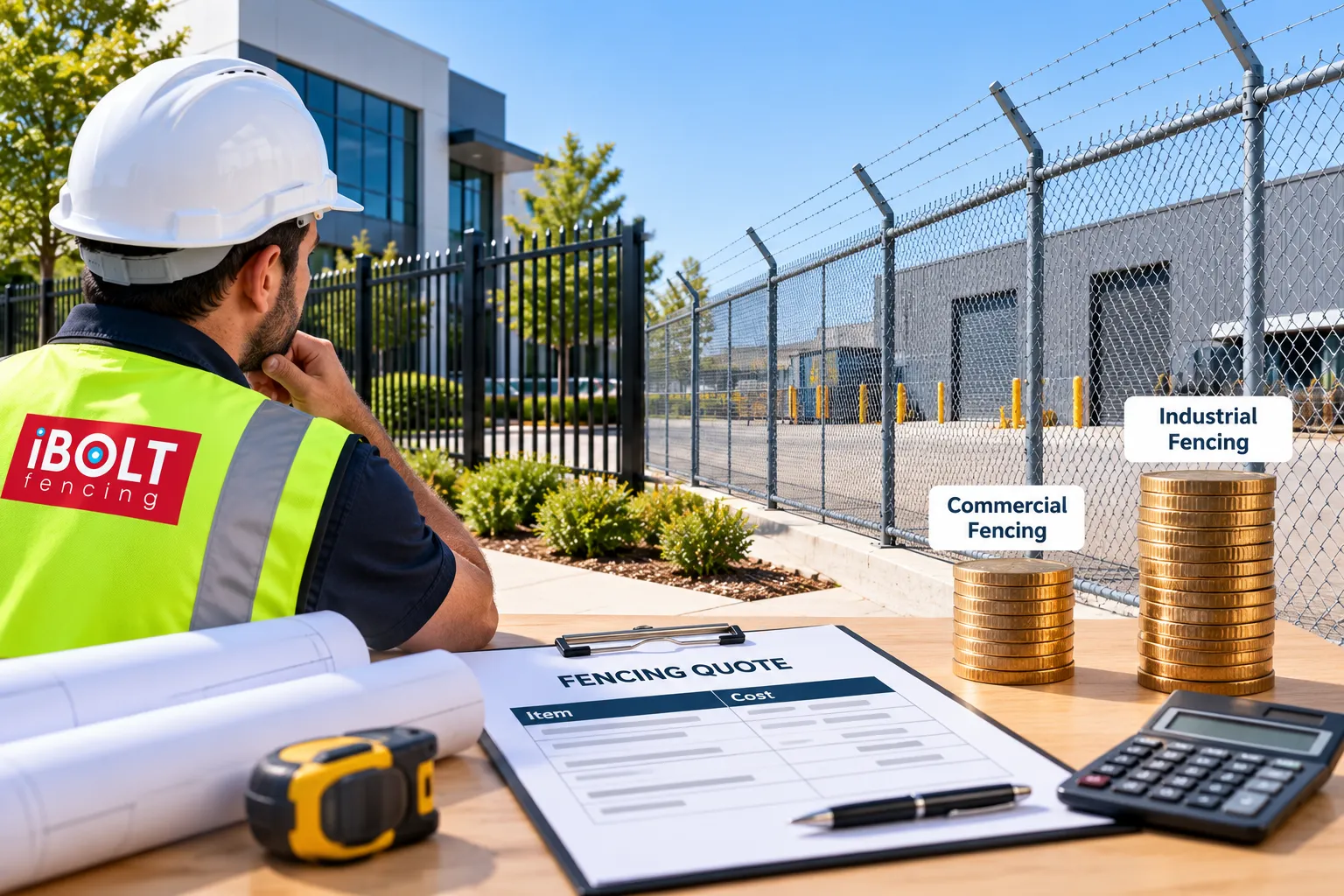
Not necessarily. Cost follows the specification, not the category. A long industrial boundary in standard chain mesh can cost less per metre than a short commercial frontage with decorative panels and an automated gate.
The main cost drivers are material grade, length and height, ground conditions, footings, coatings, gates and removal of old fencing. Ask commercial fencing contractors for itemised quotes so you can compare like with like.
How to Choose the Right Fence
Start with five questions:
-
What are you protecting: stock, machinery, people or privacy?
-
Who needs to get in, and in what vehicles?
-
Does the fence face customers or the street?
-
How exposed is the site to salt air, wind or vehicle impacts?
-
Will your access needs change as the business grows?
Many sites end up with a mix, such as garrison along the frontage and palisade around the rear yard. Perth-based iBolt Fencing installs both, along with chain mesh, C-Thru and automated gates, which keeps mixed sites simple.
Frequently Asked Questions
Is industrial fencing stronger than commercial fencing?
Usually, because it’s specified for tougher conditions. But real strength depends on the material, design, height, footings and installation quality. A well-specified garrison fence can offer serious security, while a poorly installed industrial fence can still fail.
Can commercial fencing be used for a warehouse?
Yes. Many warehouses use garrison or chain mesh, both common on commercial sites. What matters is whether the fence meets the warehouse’s security needs, gate sizes and site conditions, not which category it falls into.
What is the best fencing for a large industrial site?
Chain mesh is often the most practical option for long boundaries, while palisade suits areas that need a stronger deterrent, such as storage compounds and main entries. A site risk assessment shows where each fits best.
Can you combine commercial and industrial fencing on one property?
Yes, and it’s common. Many businesses run a neater commercial fence along the street and office entry, with heavier security fencing around yards and equipment. It balances presentation with security and can keep costs down.
Do I need a specialist for industrial fencing?
Not always. Many commercial fencing contractors handle both, but check they’ve completed industrial projects, can supply heavy-duty and automated gates, and will assess your site before quoting.
Final Thoughts
Both types do the same basic job, but they weigh security, access and appearance differently. Neither is automatically better. Match the fence to your site’s risks, traffic and environment, compare itemised quotes, and you’ll get a perimeter that protects your business for years.
