
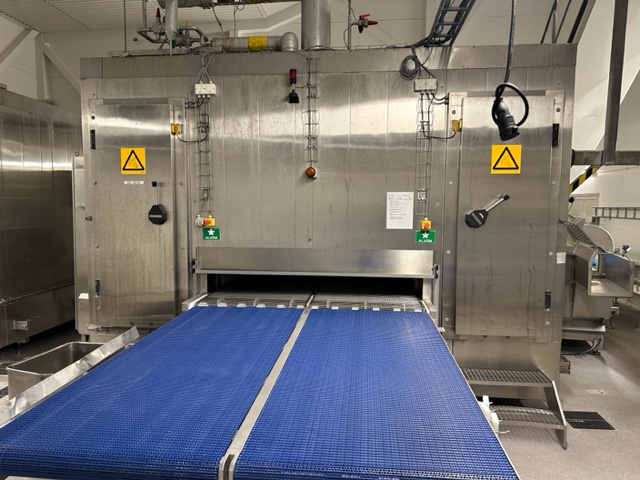
Not every food product needs to spend a long time inside a conventional freezing tunnel. For relatively thin products, the objective may be to remove heat rapidly from the surface or achieve a controlled crust-freezing effect before the next processing step.
This is where an impingement freezer can be particularly useful.
Unlike conventional air-blast systems, impingement freezing uses directed jets of high-velocity cold air to increase heat transfer at the product surface.
The technology can be valuable in specific industrial food processing applications, but its suitability depends heavily on the product.
How does an impingement freezer work?
In an impingement freezer, cold air is delivered through nozzles or other specially designed openings towards the product.
The directed airflow disrupts the relatively stationary layer of air close to the product surface. This can increase the rate of heat transfer compared with less intensive airflow arrangements.
The result may be faster surface cooling or freezing, particularly when processing products with a relatively high surface-area-to-thickness ratio.
However, impingement freezing is not equally effective for every food shape or size.
Which products are suitable?
Thin products are often strong candidates for impingement technology.
Examples can include certain fish fillets, meat portions, burger patties and other relatively flat food products.
The exact suitability depends on thickness, moisture content, product spacing and the processing objective.
An impingement system may be used for complete freezing in some applications, while in others it provides crust freezing before additional processing.
Products with irregular shapes or substantial thickness may require a different freezing approach.
What is crust freezing?
Crust freezing involves freezing the outer layer of a product without necessarily freezing the entire product to its final storage temperature.
This may help stabilise delicate products or prepare them for a subsequent manufacturing process.
For example, surface freezing can sometimes improve product handling before slicing, portioning or further freezing.
The process must be carefully controlled. Too little freezing may not achieve the desired handling characteristics, while excessive freezing can affect the intended product properties.
The appropriate time and temperature conditions depend on the product.
Impingement freezer versus conventional tunnel freezer
Both technologies can be used in continuous industrial food production, but their operating principles and strengths are different.
A conventional tunnel freezer generally moves products through an environment where cold air removes heat over a defined residence time.
An impingement freezer uses concentrated airflow to intensify heat transfer at the surface.
For thinner products, this can create advantages in processing speed. For larger or thicker products, other systems may be more suitable.
The decision should be based on the product specification rather than the assumption that one technology is universally better.
Used Frigoscandia impingement equipment
Industrial Freezing offers several types of tunnel and flow freezing equipment.
Among the listed machines are Frigoscandia Advantec impingement freezers designed for rapid freezing or crust freezing of thin products.
These types of systems can be relevant for manufacturers looking to expand or adapt a production line without automatically investing in new machinery.
Before purchasing a used impingement freezer, review the conveyor dimensions, airflow system, evaporator, sanitation arrangements and required refrigeration capacity.
Hygiene and maintenance considerations
Strong airflow and continuous product handling make hygiene particularly important.
The freezer should allow suitable access for cleaning and inspection. Conveyor condition, air nozzles and product-contact surfaces should all be assessed.
Some systems include integrated belt-cleaning equipment. Whether such a system is appropriate depends on the food products and hygiene requirements.
Maintenance planning should also consider fans, motors, refrigeration components and control systems.
Choosing an impingement freezer
The best starting point is to define what the freezing process must achieve.
Is the objective complete freezing, rapid surface freezing or improved handling before a later production stage?
Once product size, initial temperature, target temperature and hourly throughput are known, a suitable system can be evaluated.
View the current tunnel and flow freezer inventory or speak with Industrial Freezing about the right equipment for your processing line.
